
Introduction
Choosing the right air conditioning system can have a major impact on comfort, energy consumption, appearance, and long-term running costs. For many property owners, the decision eventually comes down to two popular options: ducted air conditioning and split air conditioning.
When choosing between ducted and split AC systems, it is important to look beyond the purchase price. The best solution depends on your property’s size, layout, number of rooms, cooling requirements, budget, and plans for future use. A system that works perfectly in a compact apartment may not be the most practical choice for a large villa, office, or commercial property.
This guide explains the key differences between ducted and split AC systems so you can make a more informed decision. Whether you are building a new property, renovating an existing one, or replacing an ageing cooling system, understanding these differences can help you invest in comfort without unnecessary expense.
Understanding Ducted and Split AC Systems
Before choosing between ducted and split AC systems, it helps to understand how each one operates.
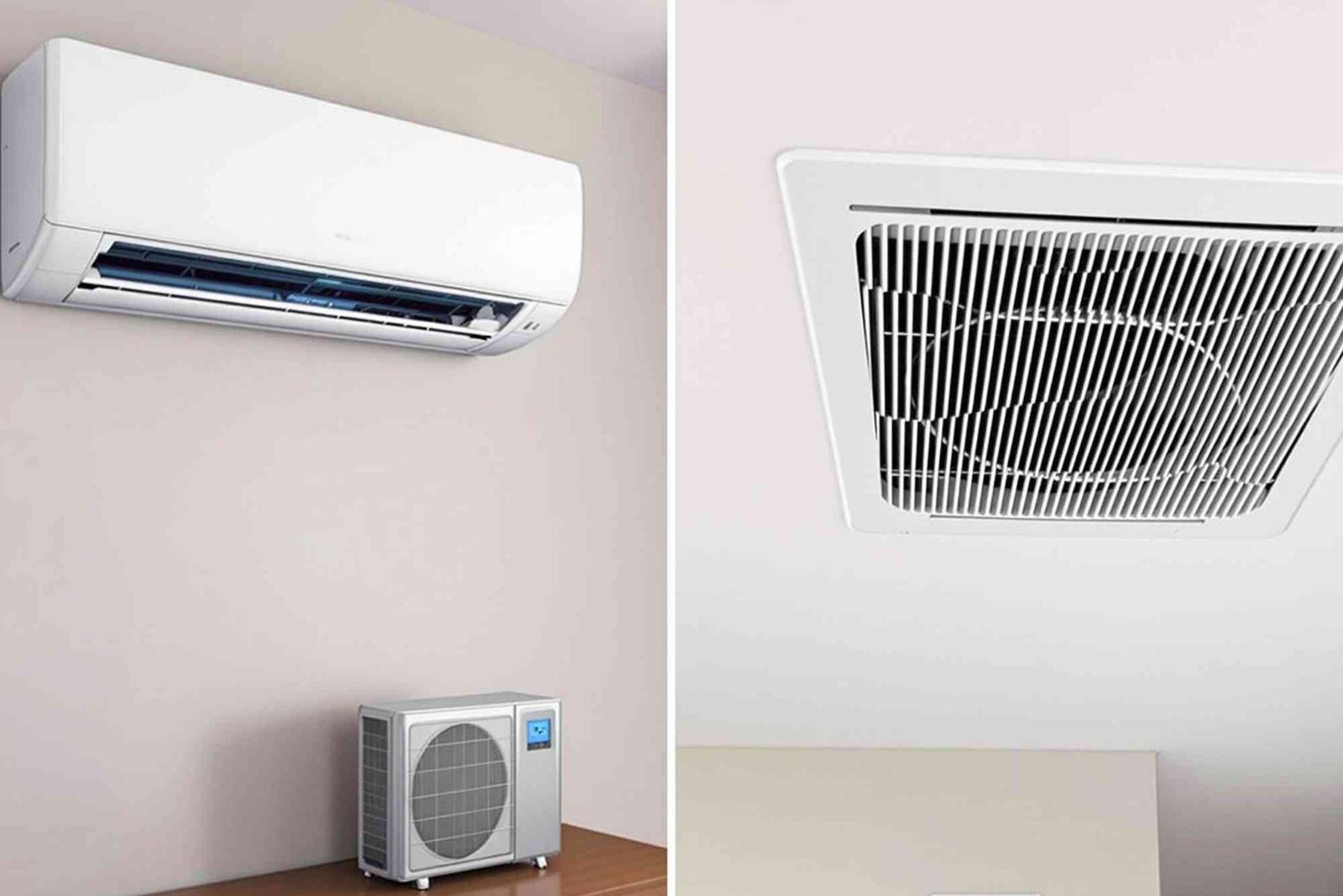
A ducted AC system uses a central indoor unit connected to a network of concealed ducts. Cool air is distributed through vents installed throughout different rooms or zones. The main equipment is generally hidden above a ceiling or in another suitable service area, giving the property a clean and integrated appearance.
A split AC system uses separate indoor and outdoor units. The indoor unit is installed inside the room it serves, while the outdoor condenser is positioned outside. Depending on the property, several independent split units can be installed to cool different rooms.

Both systems can provide effective cooling, but they approach temperature control in very different ways. Ducted systems are designed around whole-property or multi-zone cooling, while split systems are generally better suited to individual rooms or selected areas.
Ducted AC: When Does It Make Sense?
Ducted air conditioning is particularly attractive for larger properties where consistent cooling throughout multiple rooms is important.
Whole-property cooling
One of the biggest advantages of a ducted system is its ability to distribute conditioned air across several rooms. Instead of installing a separate indoor unit in every bedroom, living area, or office, a central system can serve multiple zones.
This can make ducted AC a practical choice for larger villas, spacious homes, offices, retail environments, and other properties where several areas need cooling at the same time.
A cleaner interior appearance
For homeowners who prefer a minimalist interior, ducted AC offers an important aesthetic advantage. Most of the equipment and ductwork remains concealed, with only the air vents and controls visible.
This can be particularly useful in modern interiors where wall-mounted indoor units would interfere with the overall design.
Better zoning possibilities
Modern ducted systems can be configured with different zones, allowing occupants to control cooling in selected areas. For example, bedrooms can be cooled at night while unused living spaces receive less or no cooling.
Proper zoning can improve comfort and may reduce unnecessary energy consumption compared with cooling the entire property continuously.
If you are considering this type of installation, working with an experienced ducted ac supplier can help you assess the available system configurations and determine whether your property’s structure is suitable.
Split AC: When Is It the Better Choice?
Split AC systems remain popular because they are relatively straightforward, flexible, and suitable for many individual rooms.
Ideal for individual spaces
If you only need to cool a bedroom, home office, guest room, or small living area, installing a split AC system can make more sense than investing in a complete ducted installation.
Each unit can be operated independently, allowing you to cool only the spaces that are occupied.
Flexible installation
Split systems generally require less extensive structural work than ducted systems. This can be especially important in existing properties where installing concealed ductwork would require significant ceiling modifications.
For renovations, apartments, smaller homes, and individual rooms, split AC can therefore offer a practical solution.
Independent temperature control
Each split unit can have its own temperature setting and operating schedule. This provides useful flexibility when different rooms have different cooling requirements.
For example, one bedroom may need stronger cooling than a rarely used study. With independent split systems, each space can be managed according to its actual use.
Comparing Installation Requirements
Installation is one of the most important factors when choosing between ducted and split AC systems.
Ducted systems require careful planning because the installer needs to determine the location of the central indoor unit, outdoor condenser, duct network, return-air path, vents, insulation, and controls.
The ceiling structure also matters. Properties with suitable ceiling cavities may make duct installation easier, while buildings with limited space can require more complicated solutions.
Split systems typically have simpler installation requirements. However, multiple split units can still involve considerable pipework and electrical work, particularly when several rooms require independent systems.
Professional installation is essential for both options. Incorrect sizing, poor airflow design, inadequate insulation, or improper refrigerant work can affect performance and increase operating costs.
Comparing Energy Efficiency and Running Costs
Energy efficiency should be considered alongside the initial installation price.
A split AC system can be economical when you only need to cool a small number of rooms. Instead of operating a central system, you can cool occupied areas individually.
However, a property with many split units may eventually have several outdoor and indoor components operating throughout the building. In such circumstances, a properly designed ducted system may provide a more organised approach to whole-property cooling.
The actual energy consumption depends on factors such as system capacity, inverter technology, insulation, outdoor temperature, thermostat settings, occupancy, maintenance, and how frequently the system operates.
There is no universal answer that says one system is always cheaper to operate. The right choice comes from matching the system design to the property’s actual cooling load.
Ducted vs Split AC: Which Offers Better Comfort?
Comfort is about more than simply lowering the temperature.
A well-designed ducted system can provide relatively consistent cooling across multiple rooms. Because air is distributed through strategically positioned vents, there are fewer visible indoor units and potentially fewer areas experiencing very different temperatures.
Split AC systems can provide excellent comfort within individual rooms, but temperature differences can occur between spaces when each unit operates independently.
For families where bedrooms, living areas, and other frequently occupied spaces need different temperatures, multiple split units can offer useful flexibility.
On the other hand, properties that require consistent whole-home comfort may benefit from a well-designed ducted system with appropriate zoning.
Space and Interior Design Considerations
The appearance of the property can influence the decision as much as performance.
Ducted systems are discreet because the indoor equipment is hidden. This makes them attractive for high-end homes, modern offices, hotels, and properties where interior aesthetics are a priority.
Split systems place indoor units on walls, so they are more visible. While modern units are designed to be relatively compact and stylish, they still form part of the room’s visual environment.
There is also an outdoor-space consideration. A single ducted system may use one main outdoor unit, depending on the design, while a property with multiple split systems can require several outdoor units.
Before installation, it is worth considering where outdoor equipment will be positioned and whether local building or strata requirements apply.
Maintenance and Long-Term Reliability
Every AC system requires regular maintenance, regardless of its type.
Ducted systems require attention to filters, ducts, vents, indoor components, outdoor equipment, drainage, and controls. Duct cleanliness and insulation should also be assessed where appropriate.
Split systems generally have accessible indoor filters that can be cleaned regularly. However, if a property contains multiple split units, maintaining every individual system can become more time-consuming.
Regular professional servicing helps identify issues before they develop into expensive repairs. It can also help maintain airflow, efficiency, and indoor comfort.
The quality of installation has a major influence on reliability. A correctly sized system installed according to manufacturer requirements is more likely to perform efficiently over its expected service life.
Cost: Which System Provides Better Value?
Initial cost is naturally important, but it should not be the only consideration.
A single split system serving one room may be considerably more affordable than installing ducted AC throughout an entire property. For a small cooling requirement, spending more on a central system may provide little practical benefit.
However, the calculation changes when multiple rooms need permanent cooling. Installing several independent split systems can involve multiple indoor units, outdoor units, electrical connections, refrigerant lines, and maintenance requirements.
Ducted AC may have a higher initial installation cost, particularly when ductwork and ceiling access are involved, but it can provide a more integrated solution for larger properties.
The best approach is to compare the complete lifecycle cost rather than simply comparing equipment prices.
How Property Size Influences the Decision
Property size is one of the strongest factors when choosing between ducted and split AC systems.
A small apartment with one or two regularly occupied rooms may work very well with split AC. There may be little reason to install a central duct network when only a limited amount of cooling is required.
A large villa with several bedrooms and shared living spaces presents a different challenge. Multiple split units may provide individual control, but a ducted system can offer a more seamless whole-property solution.
Commercial properties should also be evaluated according to occupancy patterns, operating hours, internal heat loads, and zoning requirements rather than floor area alone.
Considering Climate and Insulation
The local climate and building envelope also affect AC requirements.
In hot climates, air conditioning may operate for long periods during the year. This makes efficiency, insulation, shading, glazing, and correct system sizing particularly important.
Even an excellent AC system can struggle if a building has significant heat gain through poorly insulated roofs, windows, or walls.
Before deciding between ducted and split AC systems, consider how much heat enters the property during the hottest part of the day. Improving insulation and reducing solar heat gain can sometimes reduce the required cooling capacity and ongoing energy consumption.
What About O General AC Systems?
Brand selection is another consideration once you have chosen the right type of system.
Many property owners compare established manufacturers based on efficiency, available capacities, warranty support, reliability, controls, and suitability for local climate conditions. If you are researching O General ac UAE options, compare the specific model’s technical specifications rather than judging a system solely by brand reputation.
The right model should be correctly sized for the property and installed by qualified professionals. Even a high-quality AC unit cannot deliver its expected performance if it is incorrectly sized or poorly installed.
Questions to Ask Before Choosing
Before committing to either system, think about how the property is actually used.
How many rooms need regular cooling? Are all areas occupied simultaneously? Do different occupants prefer different temperatures? Is the property being renovated? Is there enough ceiling space for ductwork? How important is a discreet interior? How much are you prepared to spend upfront, and what level of long-term efficiency do you expect?
These questions can quickly narrow down the most suitable option.
It is also sensible to request a proper cooling-load assessment rather than selecting capacity based only on floor area. Factors such as room orientation, windows, insulation, occupancy, appliances, ceiling height, and local climate all influence the required capacity.
Ducted vs Split AC: Making the Final Decision
There is no single system that is best for every property.
Ducted AC is generally attractive when you want centralised cooling, concealed equipment, multiple zones, and a consistent solution across a larger property. It can be particularly suitable for new builds or major renovations where ductwork can be incorporated during the design stage.
Split AC is often the practical choice when you want flexibility, independent room control, simpler installation, or cooling for only selected spaces.
The most important point is to choose based on the property’s actual requirements rather than simply following the latest trend. An experienced HVAC professional can evaluate the building, calculate the cooling demand, explain installation requirements, and recommend an appropriately sized system.
Discover the latest news, insights, and stories from across the Arab world with Arabia Tribune. The platform brings readers informative content covering current events, business, lifestyle, culture, and more. Visit Arabia Tribune to explore engaging articles, useful updates, and fresh perspectives designed to keep readers informed and connected.
FAQs
Is ducted AC better than split AC?
Neither is automatically better. Ducted AC can be better for whole-property cooling and discreet interiors, while split AC can be more practical for individual rooms, smaller properties, and independent temperature control.
Is ducted air conditioning more expensive than split system?
Ducted AC commonly has a higher initial installation cost because it involves central equipment, ductwork, vents, and more extensive installation. However, the overall value depends on the property’s size and how many rooms require cooling.
Does ducted AC use more electricity than split AC?
Not necessarily. Electricity consumption depends on system capacity, efficiency, operating hours, zoning, insulation, and usage. A properly designed ducted system can be efficient, particularly when zoning prevents unnecessary cooling.
Which is cheaper to run, ducted or split system?
A split system can be cheaper when cooling only one or two rooms because unused areas do not need to be conditioned. A ducted system may be more practical for larger properties requiring coordinated cooling across multiple areas.
How long does ducted air conditioning last?
The service life varies according to equipment quality, installation, usage, climate, and maintenance. Regular professional servicing and timely repairs can help maximise the useful life of a ducted system.
Can ducted and split AC systems be used together?
Yes. Some properties use a combination of systems when different areas have different requirements. For example, a central system may serve main living spaces while a separate split unit handles a room with unusual cooling needs.
Choosing between ducted and split AC systems is ultimately about matching the cooling solution to the property rather than choosing the most expensive or most powerful option. Ducted systems can deliver discreet, centralised comfort across larger spaces, while split systems offer flexibility and independent room-by-room control.
Consider your property’s layout, occupancy, installation requirements, energy goals, interior design, and long-term maintenance needs before making a decision. Most importantly, have the cooling requirements professionally assessed so that the selected equipment is correctly sized.
Related Reading: التأمين السفر: الدليل الكامل — full guide
Related Reading: الأبطال: للمبتدئين والمتقدمين
Related Reading: مبادرات رسمية لدعم الابتكار — full guide
Related Reading: النوم: للمبتدئين والمتقدمين — full guide

